
He is one of the best-documented teachers of the last century, so this map can see how he lived at every level, from the ground up. That is rare, and it is why he is a useful person to read at this end of the ladder.
He sits on the top shelf, Bliss and Beyond, because the public record shows Bliss strongly. At this level it is hard to tell where people are from outside behaviour, so the shelf does not rank anyone. He operates from Community, and his largest shadow is small and sits there too. The section further down, “Why he is on the top shelf”, explains how the shelf works.
The top of the ladder, on the strength of the public record. The ground beneath it is visible and strong at almost every level.
From its healthy side. Connection, reconciliation and a place for everyone drive what he does.
The People-Pleaser. Active in 3 of 16 statements, and small. Power, Order, Responsibility and Love carry one or two each.

| Level | Healthy side | Shadow side | Shape | Reading | ||||
|---|---|---|---|---|---|---|---|---|
| Owned | Not yet | N/A | Active | Released | N/A | |||
| Belonging | 13 | 3 | 0 | 0 | 16 | 0 | healthy, clean | |
| Power | 9 | 7 | 0 | 1 | 15 | 0 | clean, well-held | |
| Order | 13 | 3 | 0 | 1 | 15 | 0 | healthy, clean | |
| Achievement | 11 | 5 | 0 | 0 | 16 | 0 | clean, well-held | |
| Community | 12 | 4 | 0 | 3 | 13 | 0 | healthy, clean | |
| Responsibility | 11 | 5 | 0 | 2 | 14 | 0 | clean, well-held | |
| Love | 14 | 2 | 0 | 1 | 15 | 0 | healthy, clean | |
| Bliss | 14 | 2 | 0 | 0 | 16 | 0 | healthy, clean | |
The scoring does not highlight one row for him, because Belonging, Order, Love and Bliss all sit within one point of each other at the top. This map places him on the top shelf, Bliss and Beyond, on the strength of the Bliss row.
This map of Thich Nhat Hanh has been read from his public life and writing rather than from answers he gave, so treat it as our best reading of the man the world saw. The survey scoring finds him strong at almost every level at once. Belonging, Order, Love and Bliss all sit at thirteen or fourteen of sixteen, so it cannot name a single level for him. We place him on the top shelf, Bliss and Beyond. He operates from Community, and his main shadow is the People-Pleaser, at three statements, the largest on a map with very little shadow.
Belonging is strong, with no shadow. He kept the traditions that still carried meaning for him, from the bell to the ceremonies of his Vietnamese Buddhist heritage, and he marked important moments with ceremony. He knew where he came from and it steadied him. He lived among people who knew one another, in the hamlets of Plum Village, and he treated places as alive and gave them respect. He felt a kinship with animals and growing things, carried forward those who came before him, and held that those who have died are still present in us. He could hold the sacred without needing it for protection, and he was comfortable with what he could not understand.
What he did not own are dreams, coincidences and signs. He lived by practice, not by omens.
Power is strong and clean. He let a slight go and held his ground without needing to win. Both the South and the North Vietnamese governments barred him from returning, and the exile lasted 39 years. He said a clear no and questioned authority. He stepped in for people who were being pushed around: the School of Youth for Social Service he co-founded in 1964 built schools and clinics and rebuilt villages. He treated his anger as information, and he wrote a book on working with it. He acted decisively and would rather try and fail than never find out.
The shadow is one statement: he would act now and deal with the consequences later. The secret rescue of boat people from Singapore is the example, and it got him expelled. What he did not own are competing, using force, and being someone people can tell is not to be pushed around.
Order is strong, with a very small shadow. He liked structure because it let him do good work, and he built it: a monastic life of fixed routines and bells, where visitors say a bell rings about every half hour and everyone stops to breathe. He postponed what he wanted for something that mattered more, kept his habits moderate by choice and kept his word when it cost him. He said the awkward thing rather than let something false stand, which is why he asked Martin Luther King to speak out against the war. He respected earned authority and questioned the rest. He worked a long time for a slow payoff, and self-discipline gave him freedom.
The shadow is one statement: excess made him uncomfortable. It is the same taste as the simple life he taught.
Achievement is solid, with no shadow. He trusted logic and knew its limits: he lectured on Buddhism at Columbia in 1962 and wrote about mindfulness in plain words. He did good work whether or not anyone noticed, set himself real goals and met them, thought several moves ahead and took calculated risks. He could stop working and be at ease, and walking meditation was a main practice. He liked finding a better way to do something and saw possibilities where others saw obstacles.
What he did not own are the louder parts: competing, wanting to be visibly the best, and wanting something to show for what he had done. The map finds no shadow here.
Community is where he operates from. He could feel what others feel and still tell where he ended. He was close to people without losing himself, he valued people nothing like himself, including people on the other side of the war, and he had enough and knew it. His inner work supported his outer life, which is what the name engaged Buddhism means. He weighed feeling and reasoning together and believed people can change. He said the hard thing, challenged authority when it was used unjustly and stayed connected through a disagreement. He belonged to his groups without needing their approval and felt a responsibility toward the natural world.
The shadow is three statements, the largest on his map and still small. He believed most people would be good if they were treated well, and he thought competition does more harm than good. He would sometimes rather keep the peace than be right. These are strengths turned over. Critics in the Unified Buddhist Church of Vietnam said his 2007 visit to Vietnam helped the government show a false picture of religious freedom. This is the People-Pleaser. It is his main shadow because it is the largest, and because it points the same way as his strengths.
Responsibility is solid, with a small shadow. When something went wrong he looked at his own part first, and the poem Please Call Me by My True Names is the clearest example. He cared whether something worked more than which camp it belonged to, so he would not take a side in the war. He saw that there are usually several workable answers. He stayed warm toward people while thinking clearly about them, took the wider consequences into account, accepted people as they were and could see why someone would think the opposite. He held his views lightly, was comfortable not knowing, and looked for the pattern connecting things. Interbeing is that pattern.
The shadow is two statements. His views sat outside the usual positions, and once he had worked something out he stuck with it.
Love is strong on the record, with one small shadow. He wished happiness to people he would never meet and felt warmth toward people at every stage of life. He acted when he saw suffering, served without needing to see that it made a difference, and could wish someone well even after they had hurt him. He could forgive someone who had never apologised, and his care did not depend on being appreciated. He gave from fullness while looking after himself. Helping was simply what he wanted, and he felt connected to all living things, people included. He could be angry with someone and still love them, and being useful mattered more to him than getting on.
The shadow is one statement: he would have felt uncomfortable with himself if he had not helped.
Bliss is strong on the record, with no shadow. His sense of being a separate person had loosened and he had become more tender toward people. Deep meditative states felt natural to him, and his practice carried itself. He could be absorbed and still meet his responsibilities, and the more settled he felt, the more he wanted to be of use. He let good states come and go and built nothing on unusual experiences. He was at peace with dying, let old fear and grief move through him, and found a quiet wellbeing that did not depend on circumstances. He could stay settled while doing something completely ordinary, such as walking or washing dishes. He held even his deepest experiences lightly.
The survey measures eight levels, Belonging to Bliss. In the wider teaching there is a tenth, Awakening, and there is no boundary between Bliss and Awakening, just as there is none between any two levels. Awakening is an unfolding, not a line someone crosses. So this map does not try to say which side of a line anyone stands on. It has one shelf for the top, Bliss and Beyond.
At this level it is hard to tell where people are from outside behaviour. Quiet, kind, unhurried and untroubled looks much the same across several levels. So the shelf is not a ranking. People are listed in alphabetical order, and no one is placed above anyone else.
Someone joins the shelf when the public record shows Bliss strongly: at least twelve of sixteen healthy statements and no more than three shadow. Thich Nhat Hanh has fourteen and none.
What makes his record different is the ground beneath. Belonging, Order, Community, Responsibility and Love are all strongly owned, with small shadows. That is the sign the survey looks for before it will stand anyone at Bliss, and for him it can be seen.
A map reads what is public: his books, his teaching, the schools and monastery he built, the praise and the criticism. His private practice, his doubts and what his days felt like are not on the record. The shelf does not say he has arrived anywhere, and it does not place him above or below anyone else on it.
Thich Nhat Hanh stood on firm ground at nearly every level at once. Belonging and Order are almost complete, Power and Achievement are solid, and Love and Bliss are strong with almost no shadow.
The People-Pleaser is the only shadow with any weight. It is the same trait that made him a reconciler: he believed in people and would sometimes rather keep the peace than be right. Critics said that cost him in 2007. The map shows a man whose strengths and shadow run in the same direction, toward connection.
A map should explain a life. Each of these five moments shows a level at work, with its healthy side, its shadow, or both.
In 1965 Thich Nhat Hanh wrote to Martin Luther King Jr. In 1966, in the United States, he met King and urged him to denounce the Vietnam War. King nominated him for the Nobel Peace Prize in 1967, and the committee made no award that year. After the 1966 trip both the South and the North Vietnamese governments barred him from returning, and he spent 39 years outside Vietnam.
Healthy side: Saying the awkward thing, and keeping to a position neither side wanted.
When 1966 to 1967, the United States.
Between about 1975 and 1978 he helped organise a secret rescue of boat people from Singapore, and Singapore expelled him when it found out. In 1978 he wrote the poem Please Call Me by My True Names, which tells of a young girl who threw herself into the sea after being raped by a sea pirate. In the poem he says he is both the girl and the pirate.
Healthy side: Acting when he saw suffering, and putting no one outside the circle.
When About 1975 to 1978, Singapore and Paris.
In 1982 he co-founded Plum Village in southwest France with Sister Chan Khong. It now has more than 200 monastics and receives more than 10,000 visitors a year. Visitors describe a bell that rings about every half hour, when everyone stops and takes three mindful breaths.
Healthy side: A place where everyone belongs, built on ritual and ordinary routine.
When 1982, southwest France.
In January 2005 he was allowed to return to Vietnam for the first time in 39 years, and he went again in 2007. Critics in the Unified Buddhist Church of Vietnam called the 2007 visit a betrayal, saying it helped the government create a false impression of religious freedom. In 2008 and 2009 the authorities asked his followers to leave the Bat Nha monastery, and in 2009 a standoff ended with police raids.
Healthy side: Staying connected across a disagreement.
Shadow side: The People-Pleaser. Keeping the peace can cost something, and critics said it did.
When 2005 to 2009, Vietnam.
In November 2014 a brain haemorrhage left him unable to speak. In November 2018 he returned to Vietnam for good, to Từ Hiếu Temple in Huế, where he had entered the monastery at 16. He died there on 22 January 2022, aged 95.
Healthy side: Knowing where he comes from, and being steadied by it.
When November 2018 to 22 January 2022, Huế.
Thich Nhat Hanh asked people to stop and breathe whenever the bell rang. The map shows what a small habit can build over a lifetime. What would your day look like if a bell rang every half hour?
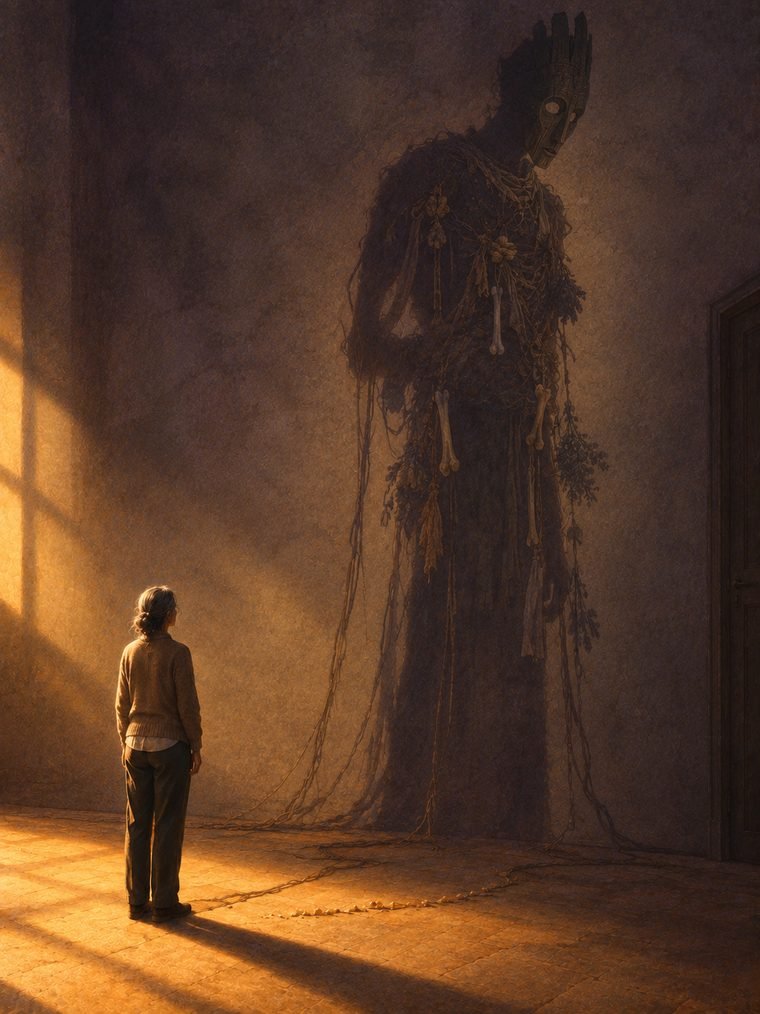
Thich Nhat Hanh’s main shadow is the People-Pleaser. Everyone has a main shadow, and it is rarely the one you would guess. The Awaken Survey places you on the same ten-level map, draws your own eight windows, and names the shadow creature that is yours.

256 statements · 20 to 25 minutes · free · every map is read personally by Peter