
He is among the best-documented of the teachers who withdrew from the world. Devotees recorded his talks, kept diaries of his days and wrote about the ashram kitchen, the animals and the routine. That lets this map see more of how he lived than it can for most people who stepped away.
He sits on the top shelf, Bliss and Beyond, because the public record shows Bliss strongly. At this level it is hard to tell where people are from outside behaviour, so the shelf does not rank anyone. The survey scoring reads him at Responsibility, because a life that stepped back from goals, rivalry and public life leaves Power, Achievement and Community thin. The section further down, “Why he is on the top shelf”, explains how to read that.
The top of the ladder, on the strength of the public record. Some levels beneath are thin, because he stepped back from public life.
From its healthy side. A fixed routine, simple habits and work done by hand drove how he lived each day.
The Onlooker. Active in 3 of 16 statements: views outside the usual positions, a best answer worth finding, and a settled view once he had worked it out.

| Level | Healthy side | Shadow side | Shape | Reading | ||||
|---|---|---|---|---|---|---|---|---|
| Owned | Not yet | N/A | Active | Released | N/A | |||
| Belonging | 11 | 5 | 0 | 0 | 16 | 0 | clean, well-held | |
| Power | 8 | 8 | 0 | 0 | 16 | 0 | lightly held | |
| Order | 10 | 6 | 0 | 2 | 14 | 0 | clean, well-held | |
| Achievement | 6 | 10 | 0 | 0 | 16 | 0 | lightly held | |
| Community | 8 | 8 | 0 | 0 | 16 | 0 | lightly held | |
| Responsibility | 11 | 5 | 0 | 3 | 13 | 0 | moderate, some shadow | |
| Love | 10 | 6 | 0 | 0 | 16 | 0 | clean, well-held | |
| Bliss | 12 | 4 | 0 | 1 | 15 | 0 | healthy, clean | |
The highlighted row is where the survey scoring reads him. This map places him on the top shelf, Bliss and Beyond, on the strength of the Bliss row. The thin rows reflect a life that stepped back from public roles.
This map of Ramana Maharshi has been read from the record his devotees kept rather than from answers he gave, so treat it as our best reading of the man they described. The survey scoring reads him at Responsibility, with Love and Bliss strong on the record and almost no shadow. We place him on the top shelf, Bliss and Beyond. He operates from Order, and his main shadow is the Onlooker, at three statements. He stepped back from public life, so Power, Achievement and Community are thin on the record, and the section below says how to read that.
Belonging is strong, with no shadow. He kept the traditions around him and took part in the ashram’s ceremonies. He treated places as alive: Arunachala, the hill at Tiruvannamalai, drew him as a teenager, and he lived on and around it for the rest of his life. His family mattered to him without swallowing him. His mother and younger brother joined him in 1916. He felt a kinship with animals, most famously the cow Lakshmi. He sensed a living intelligence behind the world and a spiritual side to it, and he held the sacred without needing it for protection. He carried forward those who came before him.
What he did not own are dreams, coincidences and the sense of those who have died as still present.
Power is solid, with no shadow. He let a slight go, held his ground without needing to win and said a clear no. When a doctor said the arm would have to come off at the shoulder to save his life, he refused. When devotees begged him to cure himself, he did not. He stepped in for others, questioned authority and acted decisively: in 1896, at 16, he left home secretly. He was loyal to the people close to him.
What he did not own are competing, being someone people can tell is not to be pushed around, and trying and failing.
Order is lightly held, with a very small shadow. He lived by a fixed routine, and structure let him do good work. He kept his habits simple by choice, postponed what he wanted for something that mattered more and did what he had committed to, from the hours of darshan to the kitchen. He said the awkward thing rather than let something false stand. His values were settled and he could still hear a challenge. David Godman writes that he took a hands-on attitude to the food cooked in the ashram and would get up in the early hours to chop the vegetables.
The shadow is two statements: disorder bothered him until it was put right, and excess made him uncomfortable. It is the same care that kept the kitchen running.
Achievement is thin, with no shadow. He did good work whether or not anyone noticed. He trusted logic and knew its limits, made his own decisions and stood behind them, and could stop working and be at ease. He wanted to be genuinely good at what he did, whether that was cooking or stitching leaf plates.
What he did not own are goals, thinking several moves ahead and calculated risks. A life that stepped back from ambition leaves this level thin. The map cannot tell whether it is absent or unused.
Community is thin, with no shadow. He could feel what others feel and still tell where he ended. He was close to his mother and to his devotees without losing himself. He valued people nothing like himself: villagers, pilgrims and, after Paul Brunton’s book in 1935, Westerners. He had enough and knew it. His inner work supported his outer life, and the kitchen is the clearest case. He cared about people while seeing them clearly, said the hard thing and belonged to his group without needing its approval.
What he did not own are the group’s politics: weighing everyone’s voice and still deciding, challenging authority and staying connected through a disagreement.
Responsibility is strong, with a small shadow. He cared whether something worked more than which camp it belonged to. The recorded Talks show him meeting each questioner where they were, and he saw that there are usually several workable answers. He stayed warm toward people while thinking clearly about them and accepted people as they were. He could see why someone would think the opposite, held his views lightly and was comfortable not knowing. He knew what he was good at and what he was not. He never claimed disciples and never named a successor, and he was content for whoever was most capable to lead.
The shadow is three statements. His views sat outside the usual positions. Once he had worked something out he stuck with it. He believed there was a best answer worth finding, and that answer was the question Who am I? This is the Onlooker. It is his main shadow because it is the largest on a map with very little, and in a teacher it is close to the shape of the work.
Love is strong on the record, with no shadow. He wished happiness to people he would never meet, felt warmth toward people at every stage of life and acted when he saw suffering. He served without needing to see that it made a difference, and his care did not depend on being appreciated. Helping was simply what he wanted. His spiritual practice was the centre of his life, and he felt connected to all living things, people included. He was happy for his giving to go unnoticed, and being useful mattered more to him than getting on. He insisted on staying accessible to everyone who came, even in his final illness.
Bliss is strong on the record, with one small shadow. His sense of being a separate person had loosened and he had become more tender toward people. Deep meditative states felt natural to him, and his practice carried itself. He could be absorbed and still meet his responsibilities, and the more settled he felt, the more he wanted to be of use. He let good states come and go and built nothing on unusual experiences. He was at peace with dying. Painful feelings passed through him without disturbing an underlying calm, and he could stay in a settled state while doing something completely ordinary, such as chopping vegetables.
The shadow is one statement: he was quite certain about what he had understood. In a teacher that is close to part of the job.
The survey measures eight levels, Belonging to Bliss. In the wider teaching there is a tenth, Awakening, and there is no boundary between Bliss and Awakening, just as there is none between any two levels. Awakening is an unfolding, not a line someone crosses. So this map does not try to say which side of a line anyone stands on. It has one shelf for the top, Bliss and Beyond.
At this level it is hard to tell where people are from outside behaviour. Quiet, kind, unhurried and untroubled looks much the same across several levels. So the shelf is not a ranking. People are listed in alphabetical order, and no one is placed above anyone else.
Someone joins the shelf when the public record shows Bliss strongly: at least twelve of sixteen healthy statements and no more than three shadow. Ramana Maharshi has twelve and one.
The survey scoring itself reads him at Responsibility. Power, Achievement and Community sit at eight, six and eight, which the scoring treats as thin ground, and it does not stand a person at Bliss on thin ground. His thin ground is of a different kind from some others on the shelf. His life is well documented, and what the record shows is a man who stepped away from goals, rivalry and public life. A life like that does not exercise those levels. Whether they are absent or unused is a question the map cannot settle.
A map reads what is public: his talks, the diaries and the accounts of those who lived with him. What it was like from inside is not on the record. The shelf does not say he has arrived anywhere, and it does not place him above or below anyone else on it.
Ramana Maharshi stood on a few levels firmly and left others quiet. Belonging, Responsibility and Love are strong, Order carries the daily routine, and Bliss is strong on the record with one small shadow. Power, Achievement and Community are thin, the mark of a life that stepped back.
He claimed no disciples and named no successor, and the Onlooker is the shape of that: a view from the side. The map shows where the record stands. It cannot see what it was like from inside, and it does not rank him against anyone on the shelf.
A map should explain a life. Each of these five moments shows a level at work, with its healthy side, its shadow, or both.
In July 1896, aged about 16, Venkataraman had a sudden fear of death. Through self-enquiry he concluded that the body dies but the Self does not. On 29 August he left home secretly, telling his brother he had a class, and boarded a train. He reached Tiruvannamalai on 1 September 1896, and he stayed near the hill for the rest of his life.
Healthy side: A sense of a separate self that dropped away, and peace with dying.
When July to September 1896, Madurai and Tiruvannamalai.
In 1916 his mother, Alagammal, and his younger brother joined him. His mother took up the life of a renunciant and ran the ashram kitchen. She died on 19 May 1922 while he sat beside her. In December 1922 he settled at the foot of the hill near her tomb, which became the core of Sri Ramanasramam.
Healthy side: Family that mattered deeply without swallowing him.
When 1916 to 1922, Skandashram and Tiruvannamalai.
David Godman writes that the popular picture of him doing nothing but sitting in samadhi is inaccurate. He was active in ashram work such as cooking and stitching leaf plates, and he took a hands-on attitude to the food that was cooked and served. He would get up in the early hours to chop the vegetables for the day’s meals.
Healthy side: Doing the ordinary work by hand, whether or not anyone noticed.
When Daily, for years, at Sri Ramanasramam.
The cow Lakshmi lived at the ashram. When she died on 18 July 1948, Ramana composed a Tamil verse that evening, confirming her liberation. Her samadhi, with the verse, is still shown at the ashram.
Healthy side: Kinship with all living things, and care that did not depend on being appreciated.
When 18 July 1948, Sri Ramanasramam.
In November 1948 a small cancerous lump was found on his arm. There were four operations in 1949, and when a doctor said the whole arm would have to come off at the shoulder, he refused. When devotees begged him to cure himself, he reportedly said, Where can I go? I am here. He insisted on staying accessible to everyone who came, even during the final illness. He died on 14 April 1950 at 8:47 in the evening.
Healthy side: Painful feelings passing through him without disturbing an underlying calm.
When November 1948 to 14 April 1950.
Ramana chopped vegetables before dawn and sat with anyone who came. The map suggests the ordinary work and the stillness may be the same thing. What in your day could you do slowly, by hand, with no one noticing?
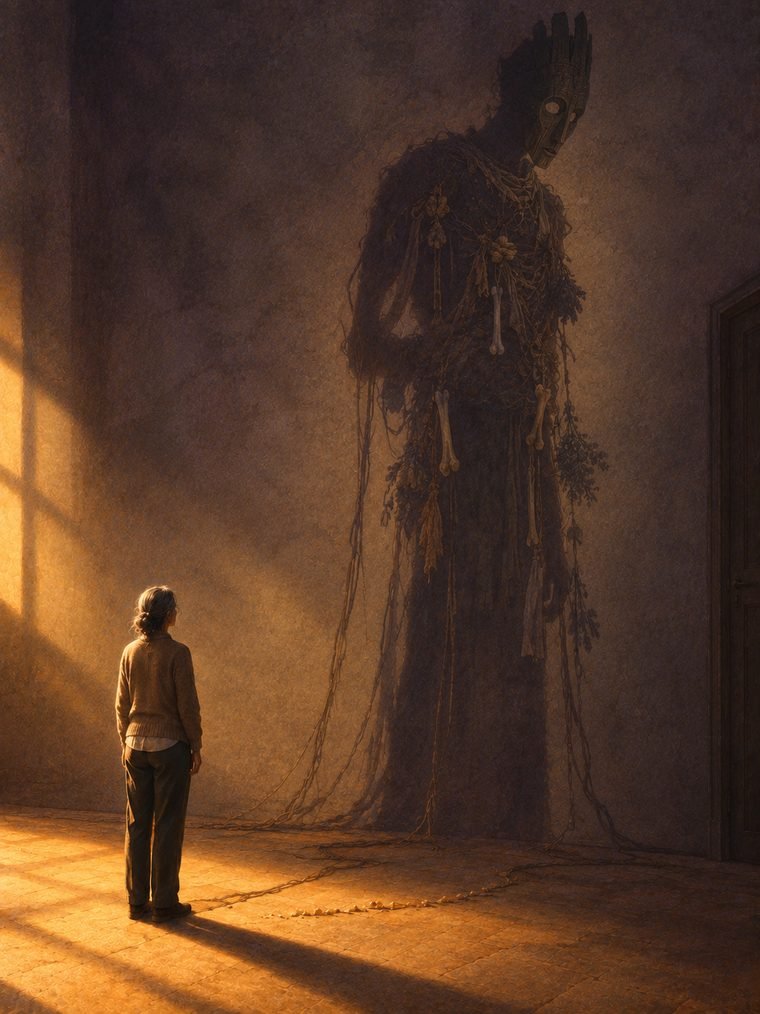
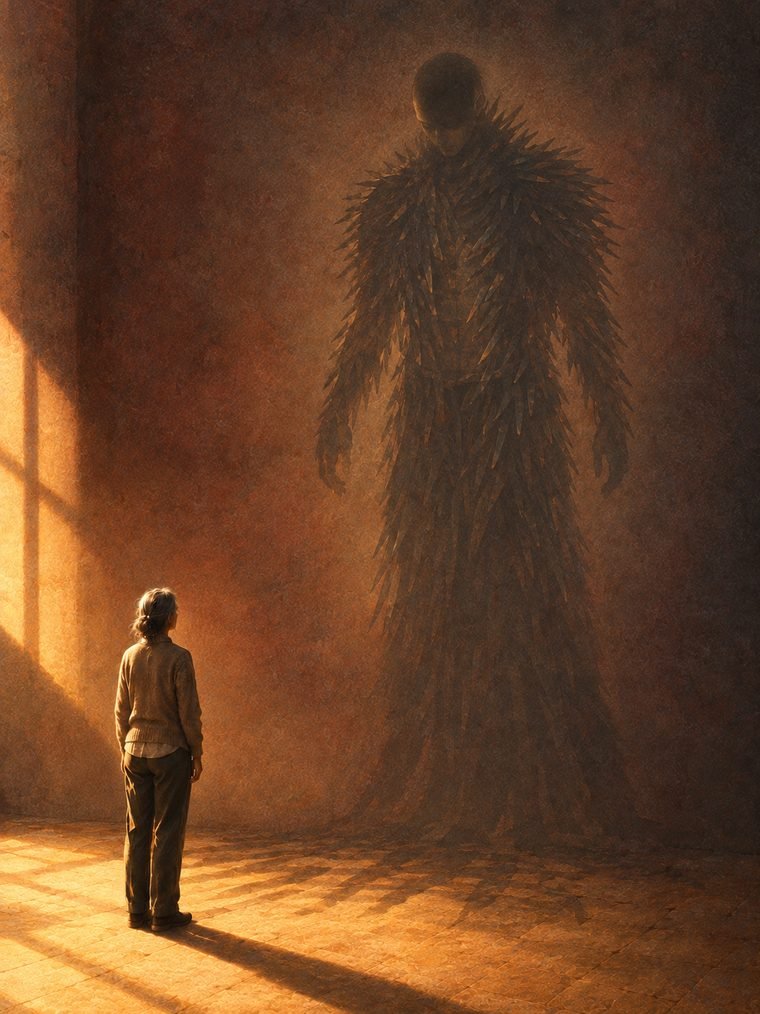
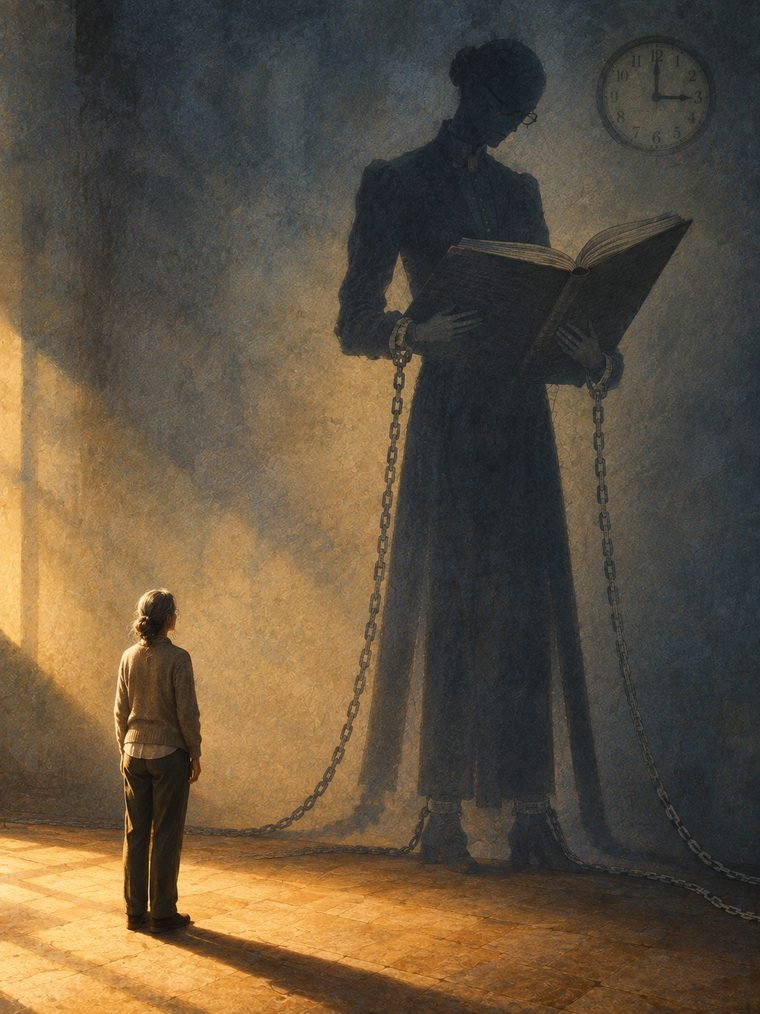
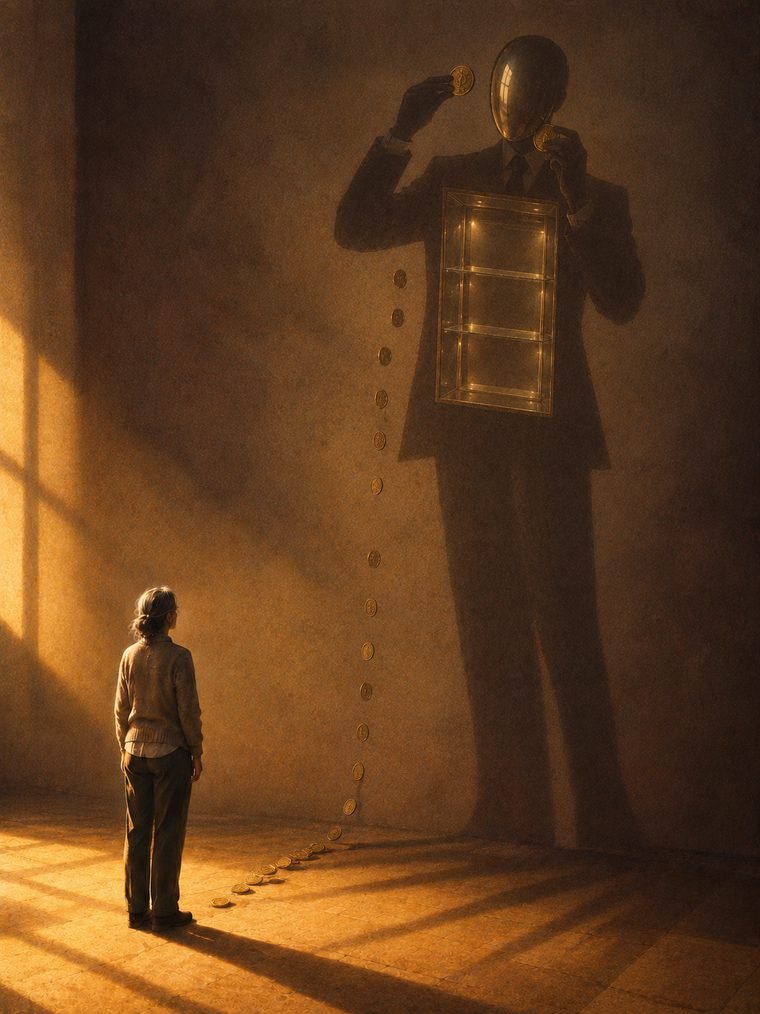
Ramana’s main shadow is the Onlooker. Everyone has a main shadow, and it is rarely the one you would guess. The Awaken Survey places you on the same ten-level map, draws your own eight windows, and names the shadow creature that is yours.
256 statements · 20 to 25 minutes · free · every map is read personally by Peter