A short teaching — June 2026
Prefer to read? The full piece is below.
Over the years I’ve taught meditation to a lot of people. And there’s one thing that has genuinely perplexed me the whole time.
Some people take to meditation straight away. They practise every day, their sessions get longer, and the benefits start to stack up. But if I’m honest, they’re the minority. Most people struggle to keep it going — even when they’re motivated, even when they’ve felt the benefits, even when they want to.
For years I’ve watched this happen and asked myself the same question: there is so much good in a daily practice, so why do so many people give it up?
I think I’ve found an important part of the answer. And it has very little to do with willpower.
It’s not that you’re “bad at meditation”
If you’ve tried to build a meditation habit and it keeps slipping away, the usual story you tell yourself is that you’re undisciplined, or too busy, or just “not a meditator.”
I don’t think that’s it.
There’s a model from psychology called Spiral Dynamics that maps how human beings develop — not in terms of intelligence or age, but in terms of how we see the world and what drives us. It was developed by Don Beck and Chris Cowan, building on the research of the psychologist Clare Graves, and later woven into Ken Wilber’s integral framework. (If you want to go deeper, it’s well worth a search.)
The basic idea is that we move through a series of stages, or levels — and the level you’re operating from quietly shapes everything, including how well meditation actually works for you.
A quick map of the levels
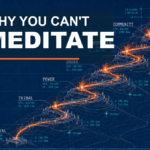
Here’s a simplified version. Most of us move up through these over a lifetime — and you’ll often recognise different levels in different areas of your life:
- Survival — the most basic level: just getting through.
- Tribal — belonging, kin, the safety of the group.
- Power and dominance — bending the world to your will. Think of the strongmen of history; Vladimir Putin is an obvious example. A level inclined toward force.
- Order and obedience — we follow the rules, respect the law, do things properly.
- Achievement and entrepreneurship — we learn to bend the rules to suit our goals.
- Sharing and community — we start to look after the group, not just ourselves.
And it keeps going from there. The point isn’t to memorise the list. The point is that we genuinely develop through these stages — as individuals, and even as whole societies.

The levels that unlock deep meditation
Here’s where it matters for your practice.
When we talk about the deep rewards of meditation — the bliss, the rapture, the profound peace — those states don’t arrive by force. They arrive when the mind is open and able to simply accept what is.
And that openness is blocked by certain views about the world. A mind that’s organised around dominance and force, for example, is working against the very thing meditation asks of it. You can’t muscle your way into a meditative state. The patterns that serve you at an earlier level — pushing, controlling, forcing — are exactly the patterns that get in the way.
This isn’t to say meditation has no benefit at the earlier stages. It absolutely does. But in my experience the deeper states — where meditation really takes off — tend to open up around the higher levels of development.
You can’t skip levels — but you can speed them up
Here’s the catch, and it’s an important one: you can’t leap from a lower level straight to a higher one. You have to grow through them, step by step, in order.
That can sound discouraging. It isn’t meant to be. Because there’s a second half to it: you can absolutely speed up the journey.
This is exactly where good coaching, mentoring and therapy earn their place. They help you work through the views and patterns that keep you stuck, and they move you — faster than you’d manage alone — toward a state of mind that’s not only happier and more productive in everyday life, but far more open to deep meditation.
So if your practice keeps stalling, the most useful question might not be “How do I force myself to meditate more?” It might be “What’s the next stage of development for me — and what’s getting in the way?”
Something to sit with
I’ll leave it there for now — this is a big topic and I’ve only given you a doorway into it. But I hope it reframes something.
If you’ve tried meditation and it “didn’t work,” it may not be a failure of willpower at all. You may simply have been meeting it from a level of mind that wasn’t yet ready for it — and that can change.
I’d genuinely love to know if this lands for you. Has this put your own experience of meditation into a new perspective? Leave a comment below, or email me — I read them.
All the best,
Peter
Want to go deeper?
If this resonated, my free Wake Up Workshop is the natural next step — a live, practical session on how to actually wake up your mind and keep a practice going. New sessions run regularly.
Want a place to actually practise?
Our Sunday Meditation is free, online, and open to everyone — no experience needed. It’s a good place to start building a practice with the support of other people, which makes the whole thing a lot easier to keep up.